
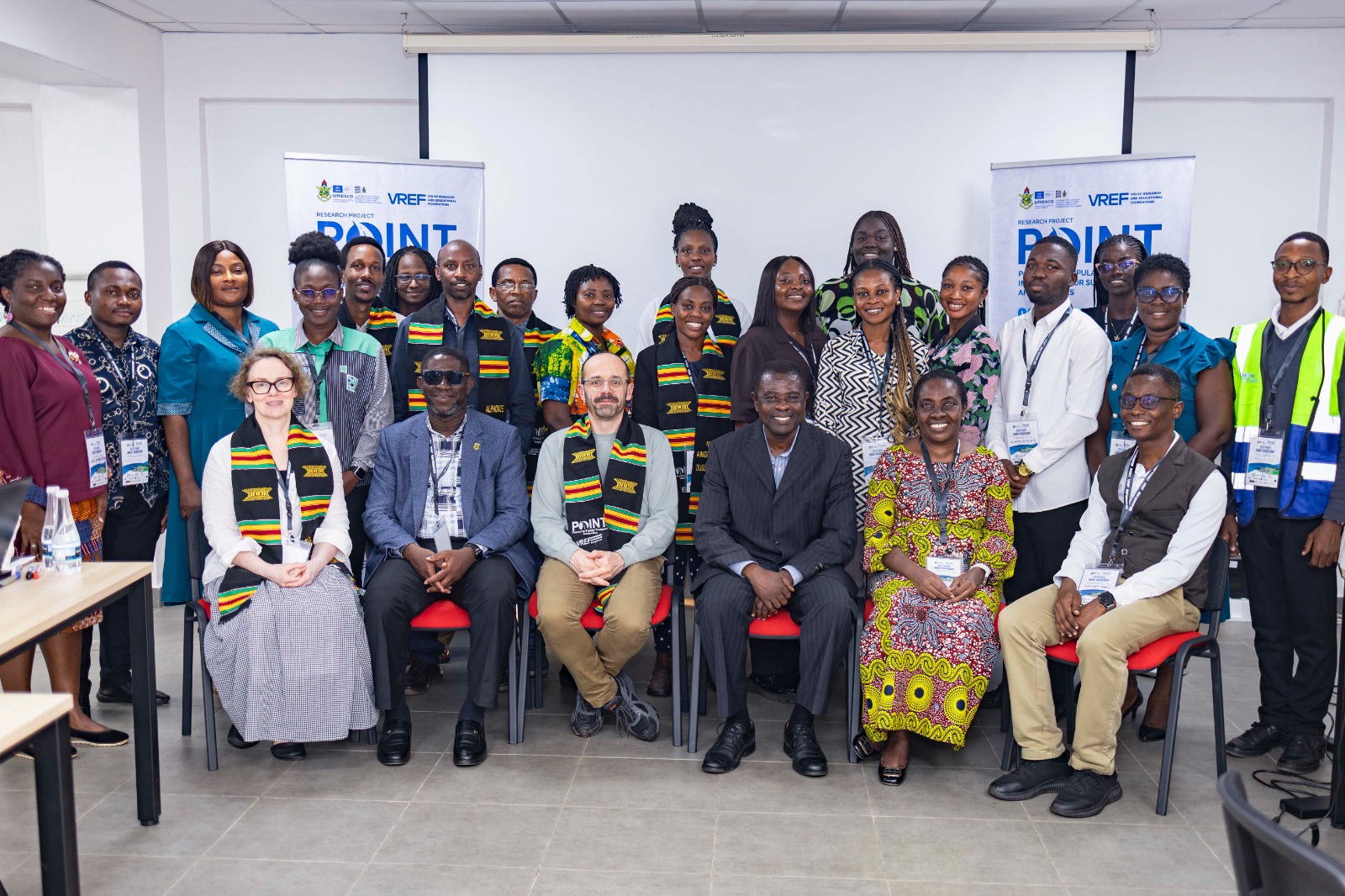
The TCC International Centre for Innovation, Manufacturing, Technology Transfer and Entrepreneurship (TCC-CIMET) has hosted researchers for a workshop under the POINT (Popular-to-Popular Transport Integration) Project, an international initiative aimed at strengthening sustainable urban mobility research in Sub-Saharan Africa.
Supported by the Volvo Research and Educational Foundations, the POINT Project seeks to co-create practical, evidence-based solutions to urban transport challenges in Ghana and Rwanda. The initiative focuses not only on transport systems and statistics but also on the lived experiences of people who depend on minibuses, motorcycles, tricycles, shared taxis and walking for their daily mobility.
The workshop was organised to develop research instruments that will support consistent and reliable data collection across the project.
Speaking at the workshop, Co-Principal Investigator and Director of Business Development and Sustainability at TCC-CIMET, Prof. Alexander Boakye Marful, said the meeting was intended to align the work of all research teams involved in the project.
He said bringing the teams together would help harmonise research procedures, facilitate knowledge exchange and establish common standards for data collection and analysis. According to him, the collaborative approach would ensure that project partners conduct their work in line with internationally recognised standards, thereby improving the quality, credibility and impact of the research.
The POINT Project is being implemented at the Kwame Nkrumah University of Science and Technology (KNUST) through TCC-CIMET under the leadership of Prof. Francis Davis. The project is led by Principal Investigator Dr. Josephine Malonza in collaboration with researchers from Aalto University, the University of Oxford and the University of Rwanda.
Addressing participants, Prof. Francis Davis highlighted the importance of understanding informal and everyday transport systems in African cities.
“The POINT Project asks us to look closely at the everyday mobility of ordinary people and to treat the minibus, shared taxi, tricycle, moto-taxi, and even the simple act of walking as systems worthy of serious study and thoughtful design,” he said.
As part of the workshop, the research team paid courtesy calls on the Kumasi Metropolitan Assembly and the Sunyani Municipal Assembly to engage stakeholders and discuss transport challenges in the two municipalities, which have been selected as the project's study sites in Ghana.
The workshop forms part of the project's broader efforts to develop inclusive and sustainable transport solutions that reflect the realities of urban mobility across Africa.


